
Key facts
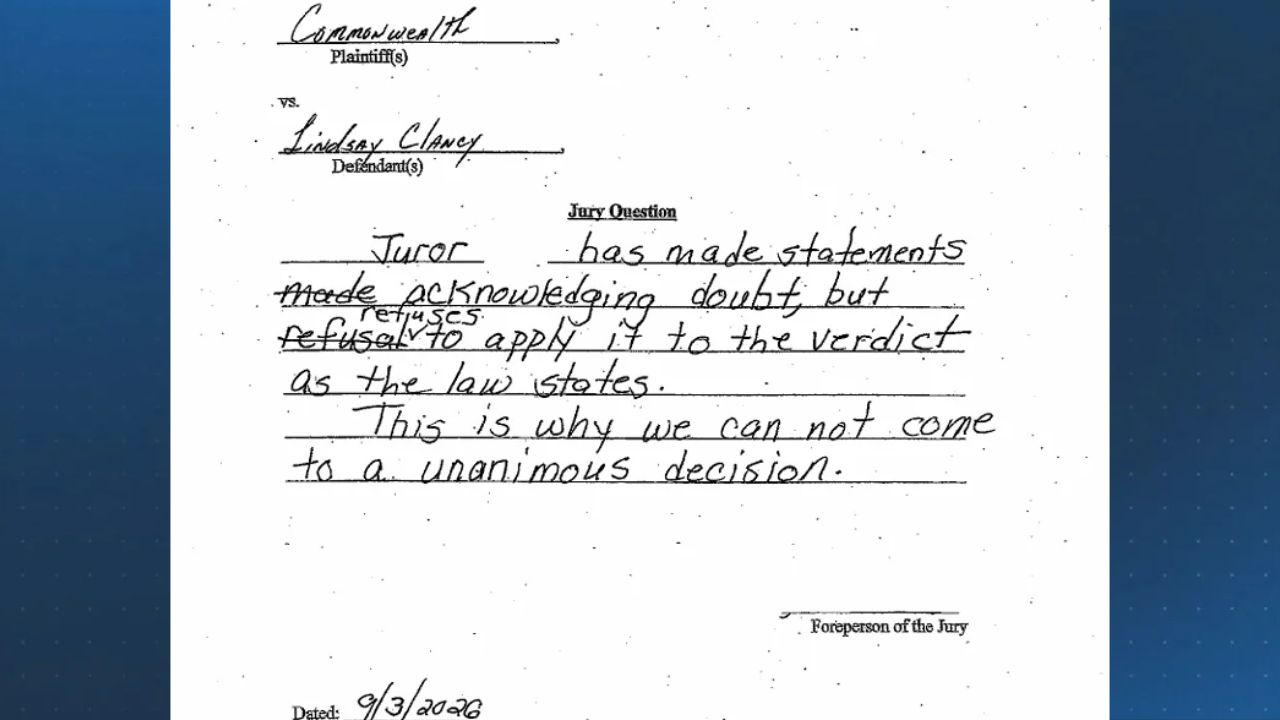
- Newly released notes written by the jury foreperson during Lindsay Clancy’s murder trial include concerns that a juror was not following instructions on reasonable doubt1
- Clancy’s attorneys filed a petition with the Massachusetts Supreme Judicial Court on Monday, Nov. 16.1
- Clancy’s attorneys said that could have provided an alternative to declaring a mistrial.1
Notes written by the jury foreperson to Judge William Sullivan during the Lindsay Clancy trial, when the jury couldn’t decide whether to convict or acquit Clancy, have been revealed.2
The notes include concerns that a juror was not following instructions on reasonable doubt.1
Clancy’s attorneys argue the notes should have prompted a more extensive inquiry into whether the juror was refusing to follow the law.1
What the notes said
A later note identified a juror and said the juror “has made statements acknowledging doubt, but refuses to apply it to the verdict as the law states.”1
During the trial, Sullivan individually asked the jurors whether they were able to follow his instructions on the law.1
Each juror said they could follow the judge’s instructions.1
The judge rejected defense requests to specifically question them about the reasonable-doubt instruction or ask the foreperson for more information about the notes.1
Defense attorney Kevin Reddington argued at the time that the limited questioning “does not focus on the issue” and requested further inquiry into the juror.1
Judge rejects mistrial argument
William F. Sullivan said under the statute and the case law, he didn’t feel he had any choice but to declare a mistrial.1
Clancy’s attorneys argue the mistrial was not a “manifest necessity,” the legal standard at issue when determining whether someone can be retried after a mistrial declared over the defendant’s objection.1
Sullivan rejected that argument in a Nov. 9 ruling denying Clancy’s motion to dismiss.1
The judge concluded the foreperson’s notes did not reasonably show that the holdout juror was unable to deliberate or refusing to follow the law.1
The judge said the notes instead reflected a disagreement among jurors and found that questioning the known holdout juror in a deadlocked jury could have been coercive and risked improperly intruding into jury deliberations.1
The judge ruled that the jury’s deadlock created a manifest necessity for the mistrial and that retrying Clancy would not violate double jeopardy.1
Appeal to the state supreme court
Clancy’s attorneys are now asking the Massachusetts Supreme Judicial Court to reach the opposite conclusion.1
The defense says Clancy should not be “forced to run the gantlet” again through a second murder trial.1
Clancy’s attorneys filed a petition with the Massachusetts Supreme Judicial Court on Monday, Nov. 16, challenging a lower court ruling that cleared the way for prosecutors to try her again.1
The defense is asking the court to reverse that decision and dismiss all three remaining murder charges.1
A second trial is currently scheduled to begin March 29, 2027.1